

The Kingdom Without the King

Updated: Oct 3, 2025
Podcast available on Apple Podcast, Spotify, or your favourite streaming platform!
I have to credit Mark Sayers for the title, but John Mark Comer’s book for the inspo behind this post. Comer so well-articulated what it has felt like to live as a follower of Jesus in our world today. The concept behind a kingdom without the King truly sums up the reality of our desires in these times.
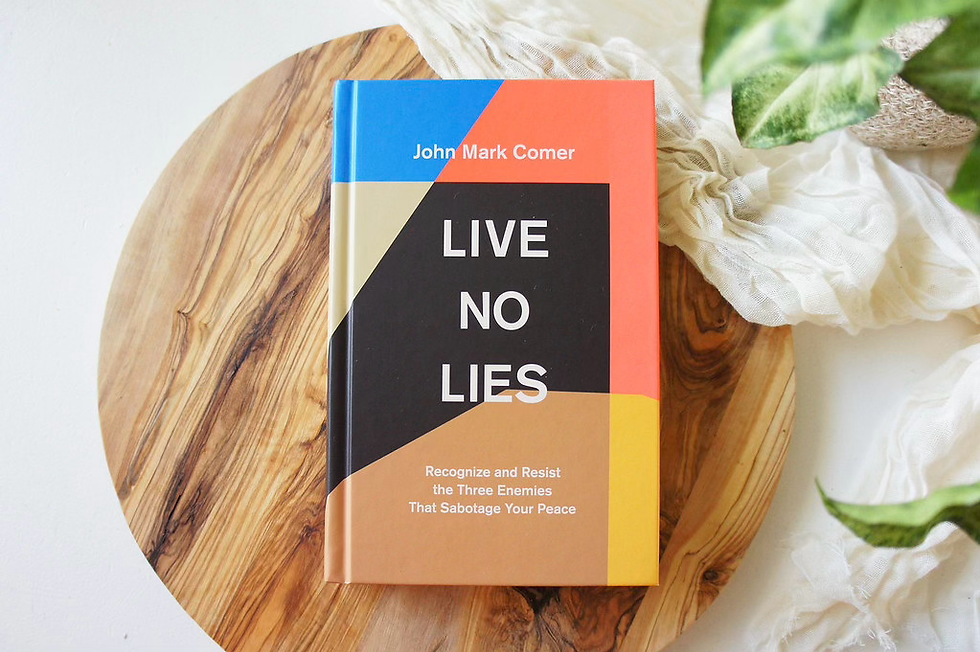
In his book, Live No Lies, John Mark Comer makes a case for the idea that as a society, we want the benefits and comforts of faith without the actual surrender of our wills to the King.
This means that regardless of your family of origin, political affiliation, faith tradition, or no faith tradition, we all want God's Kingdom to rain down on us in abundance—full of grace, mercy, and peace. BUT without any infringement on our personal rights and freedoms.
We believe the lie that self-denial or self-sacrifice is actually oppressive and unhealthy for us. So with this lie informing our decisions and relationships, it's difficult for us to then reconcile this with the command Jesus gives to lay down your life for the sake of others, or to submit to the will of God when it contradicts your own.
Believers and non-believers alike want to see Kingdom come on their own terms and the benefits of the kingdom without the boundaries of the King. The successes without sacrifice. Satisfaction without surrender. We want the abundant life Jesus offers us without actually giving him our lives in the exchange.
We see this everywhere in our cultural moment as well. Our world cries out for peace but rejects the Prince of Peace. We want reconciliation without repentance. We want justice to roll down like a river, but without the Just Judge who defines what is right and wrong. We want freedom, but without the Deliverer who tells us that true freedom is found only in surrender.
Even within the church, the pull toward “kingdom without the King” is strong. We treat Jesus like an accessory to our already busy and self-directed lives. An inspirational add-on, rather than the Lord who calls us to follow him by laying down our lives and picking up our cross out of obedience.
Consumer Christianity thrives when we ask, What can the church do for me? rather than How can I lay down my life for the sake of Christ and his people? We want sermons that inspire but don’t confront, worship that lifts us emotionally but doesn’t lead to transformation, and community that affirms but doesn’t sharpen.
The problem is, when we remove the King, the kingdom eventually collapses. It may look like it’s working for a season, but the fruit is shallow. Without surrender to Christ, justice turns into vengeance, love turns into tolerance of anything, and freedom turns into slavery to our own desires.
Love so amazing, so divine, demands my soul, my life, my all.
- Hymn by Isaac Watts, When I Survey the Wondrous Cross, 1707
That's the truth of the divine exchange. We give to God our broken, shoddy hearts and he gives us his amazing love.
But we want it on our terms.
Which means that the divine exchange is terrifying when you regard God's demands as unreasonable. When you can't trust him.
When you believe the lie that humanity has believed from the dawn of time:
God doesn't actually love you. He doesn't actually want what's best for you. He isn't actually good. And he doesn't have good in store for you.
You don’t have to search long to find where this comes from. Just check out Genesis 3. Adam and Eve, nude in the garden, wanting the knowledge of God over simply knowing God.
For God knows that when you eat from it your eyes will be opened, and you will be like God, knowing good and evil.
- the serpent, Genesis 3:5

Adam and Eve wanted what we all tend to want, which is the good things God offers, without God himself. God already made Adam and Eve in his likeness, in his image, as his children. But they believed the lie that God was withholding good from them. So they sought it out on their own terms.
As the devil convinced them, they wanted to be like God. They wanted the kingdom without the King.
If you pause and think about it, the very first temptation is still the most relevant one today.
The serpent didn’t tempt Adam and Eve with an obviously evil option; he offered them something that seemed good. He whispered that God was withholding from them, that they could be “like God” if they just reached out and took control for themselves.
That same whisper is alive in our culture. We are told daily: You are the master of your fate. You define your truth. You decide what’s best for you. Don’t let anyone limit you, not even God. At first glance, this sounds empowering. But underneath is the same old lie: that God cannot be trusted, that he is stingy instead of generous, withholding instead of providing.
What would it look like to resist that lie today? To actually believe that the God who made us knows us better than we know ourselves. To trust that his commands are not to restrict us but to set us free. The garden isn’t just an ancient story—it’s a mirror for our modern struggles with surrender.
This pattern plays out across all of Scripture.
Like when Abraham and Sarah took matters into their own hands to conceive their promised child. They grew impatient and wanted to fulfill the promise on their terms, in their timeline, in ways that made sense to them. And what a mess that made when Ishmael was born to Hagar, Sarah's maidservant, who was subsequently abused for it.
Israel did the same thing when they demanded a king in 1 Samuel 8. They already had Yahweh as their ruler, the perfect and faithful King. But they looked at the nations around them and wanted to keep up. They wanted a visible, earthly authority who fit their cultural expectations, even if it meant rejecting God’s leadership. God gave them Saul, but it came with warnings: their desire for the benefits of the kingdom on their own terms would lead to oppression, disappointment, and eventual exile.
Or consider the golden calf in Exodus 32. Moses was on Mount Sinai with God, receiving the very words of life, but the people grew impatient. Instead of waiting on the King, they made their own “god” out of gold. Something they could touch, control, and worship on their terms. The result was chaos and judgment.
Or Peter, when Jesus was about to be arrested in the garden ahead of his crucifixion. Peter also took matters into his own hands, ready to bring God's kingdom by force when he sliced off the ear of the arresting officer.
Jesus rebuked him saying,Put your sword away! Shall I not drink the cup the Father has given me?
(John 18:11)
By this time, Jesus had come to terms with the plan. The cup he was referring to, is the cup the Father had given Jesus. It was the cup of his wrath. The cup of judgement that was about to be poured out on him through his death on the cross.
In what was probably the most relatable human moment, Jesus struggled with submitting to God's will in suffering on behalf of humanity. But this Servant King could only rule the kingdom by being obedient to death on the cross. It was the only way to win our freedom. And he knew it.
The King and the kingdom. All for us.
All through the Bible, the storyline repeats: humanity trying to seize the blessings of God without the surrender that comes with trusting him. And if we’re honest, we’re not much different.
Hyper Individualism
We live in a time of hyper individualism.
If we're willing to reflect on how our hyper individualism taints our relationship with God, I think we'll find that we, too, want the kingdom without the King.
If your God never disagrees with you, you might be worshiping an idealized version of yourself. – Tim Keller
In hyper individualism, we decide for ourselves what is good or bad based primarily on how it will affect us or make us feel. And if there's a chance that anything will be uncomfortable or unpleasant, we reject it. We cancel it. With this mindset there is no room to be challenged or questioned. No space for growth.
Hyper individualism shows up everywhere. Social media trains us to curate our lives around personal brand and instant validation. Advertisers tell us that our happiness is the highest good, so try whatever makes you feel good.
Even spiritual practices are marketed to us as “self-care”—meditation without repentance, mindfulness without submission, blessings without the cross.
So it’s no wonder that this mindset has seeped into the church. We shop for a church like we shop for a phone plan: looking for the best features, lowest demands, and maximum convenience. We get uncomfortable with any message about sin or surrender, because it threatens our carefully crafted independence.
But the Gospel dismantles hyper individualism. Jesus says, “Whoever wants to be my disciple must deny themselves and take up their cross daily and follow me”
(Luke 9:23).
That is not the language of self-optimization. It’s the language of self-surrender. The way of the kingdom is not “you do you,” but “not my will, but yours be done.”
The irony is that only when we lay down our obsession with self do we discover true life. Jesus promises that the one who loses their life for his sake will actually find it. That’s the beautiful paradox of life under the King.
A kingdom WITH the King means:
I will not always understand the King's decisions
I will not always get my way
I will sometimes be forced to wait
I will be corrected
I will be challenged
I will be stretched
I will extend the forgiveness and grace I long to receive
I will swallow my pride
Is he good?
The only way we can come to terms with the King ruling the kingdom and not us, is if we can come to trust God. To take him at his word. To believe what he says about himself and his Son, Jesus, are actually true.
My eldest son will be 13 on his next birthday and we are definitely experiencing some of what comes with the teen years.
He has been asking to do something that my husband and I are simply not comfortable with him doing just yet. We had a level-headed conversation with him about it recently, (which is not always the case, trust me!) and gave him all the reasons why we are not going to allow him to do what he would like to do. Unfortunately, after going over the details ad nauseam, he just couldn't accept it.
So I had to ask him, do you believe that we have your good at heart. Do you trust us enough to believe that?
He admitted that he does.
In the end we had to ask him to simply trust his parents and submit to our decision.
Of course, in his mind, our decision still felt unfair. He cannot see the bigger picture that his parents can see. He cannot fully grasp the potential dangers or long-term consequences. And honestly, why would he? He’s 12. His perspective is limited by his experience.

And as I reflected on this, it hit me: I am exactly the same with God. When he says “no” or “not yet,” my instinct is to question his goodness. I want the details, the blueprint, the proof that his way is better. But like my son, I only see a sliver of the whole story. God sees the beginning from the end. He knows the dangers I can’t foresee, the outcomes I can’t control, and the growth I can’t yet understand.
Maybe that’s why Jesus tells us we must become like little children to enter the kingdom (Matthew 18:3). Not childish, but childlike—willing to trust that our Father knows what we do not.
Our lives with God are like that. I encourage you to ask yourself, “do I believe God is for my good? For my ultimate good? Do I trust him enough to believe him and submit to that?”
It's foolish to expect to receive the privileges of the kingdom but then not submit our wills to his. To demand of him every single gift he offers, without accepting him, the ultimate gift.
God causes his sun to shine on evil people and good people. He sends rain for the crops of those who do right and those who don’t. It’s why we are all privileged to enjoy the sight of a sunrise, the smell of a flower, and the taste of a delicious PSL from Starbucks (Matthew 5:45). It’s what the Scriptures refer to as Common Grace. And most of us live our whole lives without acknowledging God for these gifts of grace.
We blame God for the bad, but don't acknowledge him for the good. But we can't have it both ways.
So what does it look like to actually embrace the kingdom with the King? It means daily surrender. It means reordering our lives around God’s presence and his authority, not just fitting him into the margins. It means letting him define good and evil instead of relying on our own instincts, feelings, or cultural trends.
Practically, this looks like cultivating rhythms of obedience:
Submitting our desires in prayer, even when we don’t get the answers we want.
Immersing ourselves in Scripture so that God’s Word reshapes our assumptions.
Living in community that doesn’t just affirm us but also calls us to accountability.
Practicing forgiveness and generosity, even when our pride resists it.
When we choose the King, we actually get the kingdom too—justice, peace, love, joy, and hope. But when we try to take the kingdom without the King, it slips through our fingers, leaving us restless and unsatisfied.
The good news is that Jesus doesn’t just offer us an invitation; he offers us himself. He himself is the Way. He is not holding out on us. He is holding himself out for us. The kingdom is not just about a future hope; it is about living under the reign of a good and gracious King today. Even today.
What’s in the Ears
This is the part where I share a song or podcast I’m currently into. This song is one of my favourites for corporate worship during church services. It’s titled, All Hail King Jesus, by Bethel Music. Let me know if you check it out!
If this stirred something in you, share this post with a friend or drop a comment below. I’d love to hear what small step you’re taking towards the flourishing life today! And don’t forget to subscribe so you don’t miss a thing.
Podcast available on Apple Podcast, Spotify, or your favourite streaming platform!


Comments